The FOUND Method: A Simple SEO Framework for Therapists Who'd Rather Be Doing Literally Anything Else
You didn't go to grad school to learn keyword research. You went to grad school to help people. But... if your ideal clients can't find you on Google, all that clinical skill is sitting behind an invisible website (*cue the crickets*)
That's exactly the gap I built the FOUND Method™ to close.
Hey there, I'm Ashley, a licensed clinical social worker and SEO copywriter, and I spent 8+ years in the therapy room before I ever touched a keyword research tool. So when I say I get it... I really do. SEO felt like a foreign language to me too, until I broke it down into something a therapist (not a marketer) could actually use.
Let's walk through it.
What Is the FOUND Method?
FOUND is a 5-step framework that takes you from "I have no idea if anyone can find my website" to having a real, working plan to attract private-pay clients through Google. No ads. No algorithm chasing. No hiring anyone.
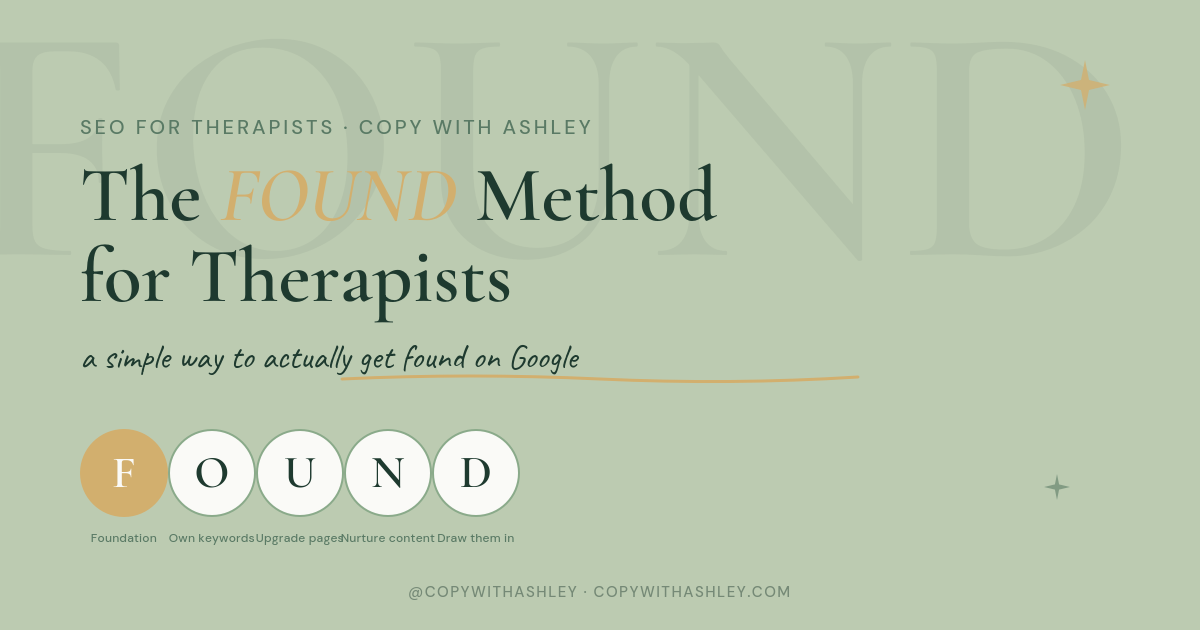
Each letter is a stage:
F — Foundation
O — Own your keywords
U — Upgrade your pages
N — Nurture with content
D — Draw them in
Let's go through each one.
F: Foundation
Before you touch a single page on your website, you need to understand what SEO actually is and how Google decides who shows up on page one.
This step covers:
What SEO really means (spoiler: it's not as technical as it sounds)
How Google's algorithm actually works
E-E-A-T, explained specifically for mental health professionals
The myths that are keeping good therapists stuck and invisible
Most therapists skip this step. They jump straight to "fixing" their website without understanding why Google ranks one page over another. That's like trying to write a treatment plan without doing the intake first. You need the foundation before anything else makes sense.
O: Own Your Keywords
Once you understand how Google thinks, it's time to figure out what your ideal clients are actually typing into the search bar.
This is where a lot of therapists guess wrong. You might assume people are searching "psychotherapy services," when really they're searching "therapist for postpartum anxiety near me."
This step covers:
Keyword research without the overwhelm
Long-tail vs. short-tail keywords (and why long-tail wins for private practice)
Understanding search intent, or what someone actually wants when they type a phrase into Google
Building your own priority keyword list, specific to your niche and location
This is the difference between showing up for the right people and showing up for no one.
U: Upgrade Your Pages
Now you take what you know and apply it to the pages you already have. Your homepage, your services page, your about page.
This step covers:
Title tags and meta descriptions (the small pieces of text that show up in Google search results... and yes, they matter)
Headers that guide both readers and search engines
Alt text for your images
Writing for three audiences at once: skimmers, deep readers, and Google itself
You don't need a new website. You need the one you have to actually work for you.
N: Nurture With Content
This is where blogging comes in, and I promise it's more strategic than "just write about stuff."
This step covers:
Why blogging works for therapy websites specifically
Google's E-E-A-T and Helpful Content standards, applied to therapy topics
How to structure a blog post so it actually ranks
Building a 3-month content calendar so you're not starting from scratch every time you sit down to write
Consistent, helpful content tells Google (and your future clients) that you know what you're talking about. Which... you do.
D: Draw Them In
Getting found is only half the job. The other half is turning that website visitor into a booked consultation.
This step covers:
CTAs that actually get clicked
A contact page that converts instead of confuses
Google Search Console basics, so you can see how your site is actually performing
A 90-day action plan to keep you moving after the learning is done
This is the step that turns "my website looks nice" into "my website is booking my caseload."
Why This Method Works for Therapists Specifically
Most SEO advice online is written for e-commerce brands or huge companies with marketing teams. It's not written for a solo practitioner with 3-4 hours a week and zero interest in becoming a full-time marketer.
The FOUND Method is built around what you actually have. A handful of hours, one website, and a genuine desire to help the right people find you. Every module is designed to be applied directly to your own site as you go, so you're not just learning theory. You're making real progress.
Ready to Actually Use the FOUND Method?
I built the full framework into a self-paced course called SEO for Therapists 101. It's 3-4 hours of video, 11 hands-on worksheets, and zero tech jargon. If you can update a page on your website, you can do this course.
Learn more about SEO for Therapists 101 →
Your ideal client is on Google right now, searching for exactly what you offer. Let's make sure they can actually find you.
